
A loose blanket of mist hangs over 8 Mile Road in Sonada, Darjeeling, punctuated by cars racing past the TIEEDI gate.
In their hurried pursuit, most tourists miss a curious sight: five people in green tracksuits emblazoned with #ZeroWasteAndolan, pushing a trolley filled with buckets across the toy train tracks that define this Himalayan town.
The buckets contain a blend of broken eggs, vegetable excess, and chicken feathers. Wet waste, or the soul of our compost. What bestows life and nitrogen to infertile soil.
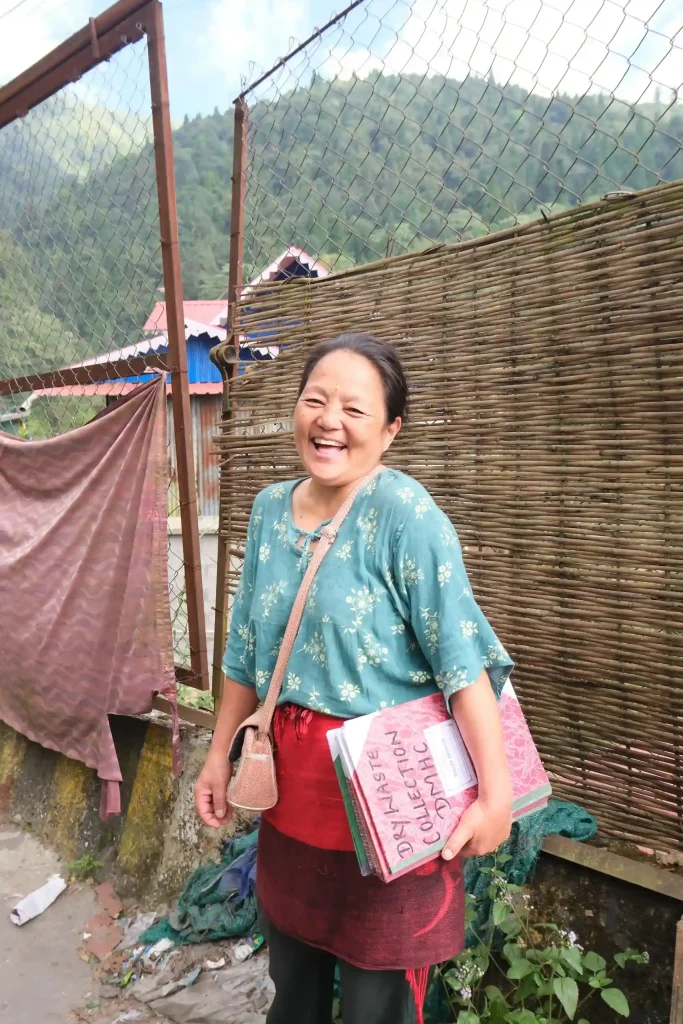
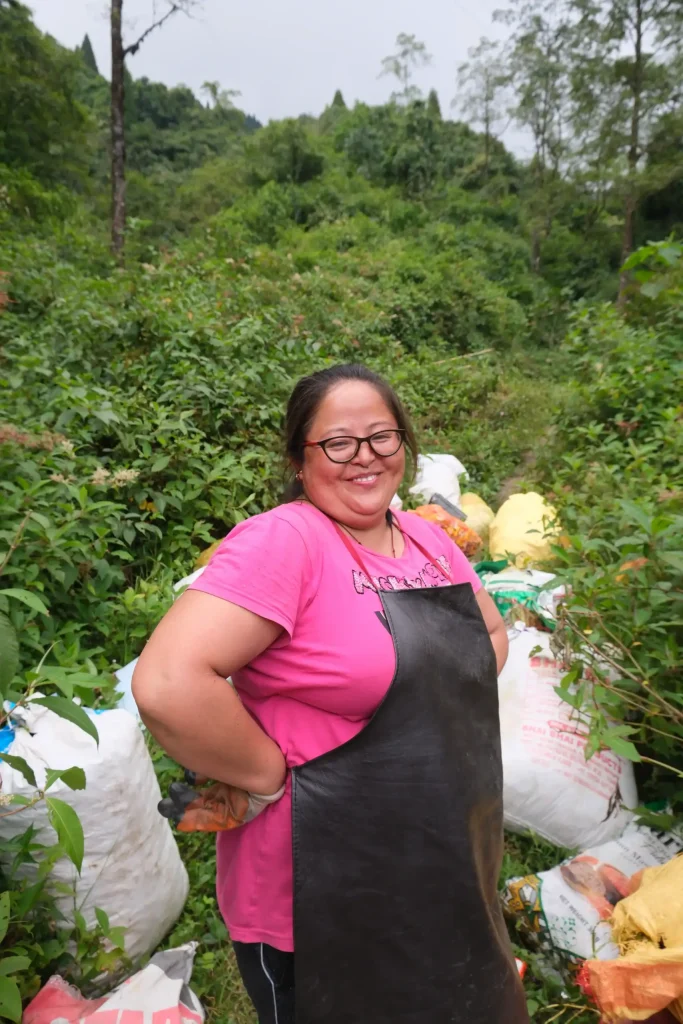
Each morning, our Green Mile team: Rita Rai, Riwaz Tamang, Anamika Rai, Chaum-di, and Amit, walk along NH-110 in Sonada, collecting bio-degradable and non-biodegradable waste from roadside restaurants. Their work also extends to the neighboring villages of Naya Basti and Rajahatta, now equipped to become zero-waste communities through our Green Mile Project.
The sacks and buckets collected shape their days in the Material Recovery Facility (MRF), a three-storey building with a compost chamber below. Above it, a space where dry waste is sorted manually into 53 distinct categories.
Yes, 53.

Sorting What Never Goes Away
To the detached inhabitant of Earth, waste is a blur, an ugly amalgam we’d rather not look at. However, to the ones that work hands-deep in it, waste looks different.
It needs to be broken down to its essence: hard, colored, and clear plastic; tin; cloth; cigarette and gutka packets. It’s never simple: food wrappers still slick with grease; plastic tubs stuffed with broken eggs. Every fragment is scrutinised before it finds its rightful pile. An arduous task.
The trough in the centre seems to never empty. The minute it is, a new sack is unloaded, beginning the cycle again. That is the thing about waste management; the comfort of completion forever slips past those who work with it.

The People Behind the Procedure
Anamika sings in her native Nepali as she sorts through the waste. Her sweet voice weaves through the meticulously arranged room, silent except for the shuffling of plastic. Against the walls are sacks of organised waste due to be sent to processing units.
Much of the room is claimed by waste that cannot be saved, like disintegrating shoes. Behind the office, a steel trunk sits heavy with soiled diapers. Collected five years ago and left to outlast their owners.
“We’ve been doing years of outreach,” Anamika says. “We personally go door-to-door to tell people how to wash, segregate, and pack their waste. It breaks me a little when we still receive dry waste covered in slime.
Rita, ever the spirited one, picks up a discarded makeup sponge and pretends to apply blush. Laughter ripples through the room. The humor fades quickly, though. The sponge is made of polyurethane foam, non-biodegradable and non-recyclable. A moment’s vanity. A millennium underground.
During a break, Rita shares fragments of her life with me. Rajahatta, her ‘maika,’ (mother’s hometown), used to be clean all the time. Her eyes gleam as she speaks of the frock she once loved, its pockets filled with chivda and bhujia.
“Pulling out fistfuls of bhujia from my pocket used to delight me so much!” she says, laughing. “Now kids won’t eat unless it comes in a plastic packet or box.”
The Uphill Work of Change in a Zero Waste Village
We watched cars hurtle past. Empty Mazza bottles arced out of windows, and the tracks were carpeted with chips packets.
I ask Rita if this feels disappointing. Her team has been walking up and down these roads for years, speaking to households about waste. Everyone here knows what TIEEDI stands for. This is meant to be a Zero Waste Village, yet few seem to live by it.
Rita tells me the work has been an uphill climb. When the team asked nearby restaurants to tell tourists not to litter, most hesitated. “They’re scared,” she says. “They think if they say anything, no one will come to eat.”
Convincing local restaurants to act was no small feat. “They’re scared,” Rita admits. “They think if they tell tourists not to litter, people won’t come to eat.”
Initially, the team collected waste for free, but even that came with strings attached. “They wanted us to collect from inside or sort it ourselves,” she sighs.
Occasionally, the crunch of plastic under tires pierces her words.
“I can’t understand why no one wants to change. There is cancer [linked to burning waste] in almost every house,” she says softly. “Our actions can earn the breaths of our parents.”

Teaching the Next Generation to Do Better
And yet, hope refuses to vanish. It takes a subtler form, often in places the streets cannot reach.
In classrooms, small hands pick up the lessons that adults struggle to carry.
Since 2023, TIEEDI’s Holistic Waste Management Program has entered local schools, planting micro-MRFs and designing eco-education curricula that teach children not just to segregate waste, but to become custodians of the Earth.
At Darjeeling’s Montessori House of Children, laughter spills as students wash bottles and sort plastics. Through its Everyday Environmentalism Program, the school has turned waste management into a living practice: students bring non-biodegradable waste from home for daily segregation at school, and the collected materials are sent to TIEEDI’s Material Recovery Facility (MRF).
This hands-on initiative has reduced the school’s waste footprint, empowered children as young changemakers, and inspired 300 households, through 250 students and 50 staff, to adopt Zero Waste practices at home.
An eight-year-old even transformed his family’s business into a zero-waste shop, while another group organized a hair-cutting drive after learning that human hair can absorb oil spills.
At St. Joseph’s School, children arrive each morning with beverage cartons from home, while students at DMHC proudly bring segregated waste to their school’s micro-MRF—guiding parents and visitors in composting with patience.
Fragile, yet relentless. The children’s actions promise a future in which mindful engagement with the Earth is less an exception, and more the bedrock for a new way of living.

Keeping Hope Alive
Back in the MRF, Rita bends over the sorting trough.
She pauses, looks straight in my eyes, and murmurs, “Even when my head hits the pillow after a long day… I dream of sorting waste.”
The others laugh softly. A ripple of fatigue and understanding. I linger in that space between helplessness and empathy, unable to look away. In her eyes, I see the same Rita who once confided that her only dream was to stop waiting for people to change.
Then I think of the children with their steady persistence and hope that dwarfs our defeat.
I wish Rita could rest with that image in her mind, instead of a moldy tub left unwashed by an adult.


