
My vehicle meanders through Takdah forest. I listen to the trees breathe with the air: pine, cedar, rhododendron. For a moment the forest is a chamber of memory, with lovers ducking under branches and children tilting their faces to the canopy, dreaming past the leaves.
Then the edge breaks the spell. Glints of plastic and glass fracture the green. Empty alcohol bottles idle on roots. Gutka sachets snag in the grass.
On paper, this slope belongs to a system that promises segregation at source and clean exits for every material. This means that homes sort into wet, dry, and hazardous and the Gram Panchayat enforces collection. Brands pull back their plastic waste through Extended Producer Responsibility, though it has scarcely been implemented in a way that empowers grassroots organisations.
Darjeeling has nine blocks, and each should run a Plastic Waste Management unit. In reality, only three operate: Takdah, Garidhura (Kurseong), and Matigara (Siliguri subdivision).
I arrive at one of the few places where the promise of waste management is kept: a modest building with sacks of plastic resting at its mouth. This is the waste segregation unit at the Rangli Rangliot Block, Darjeeling.
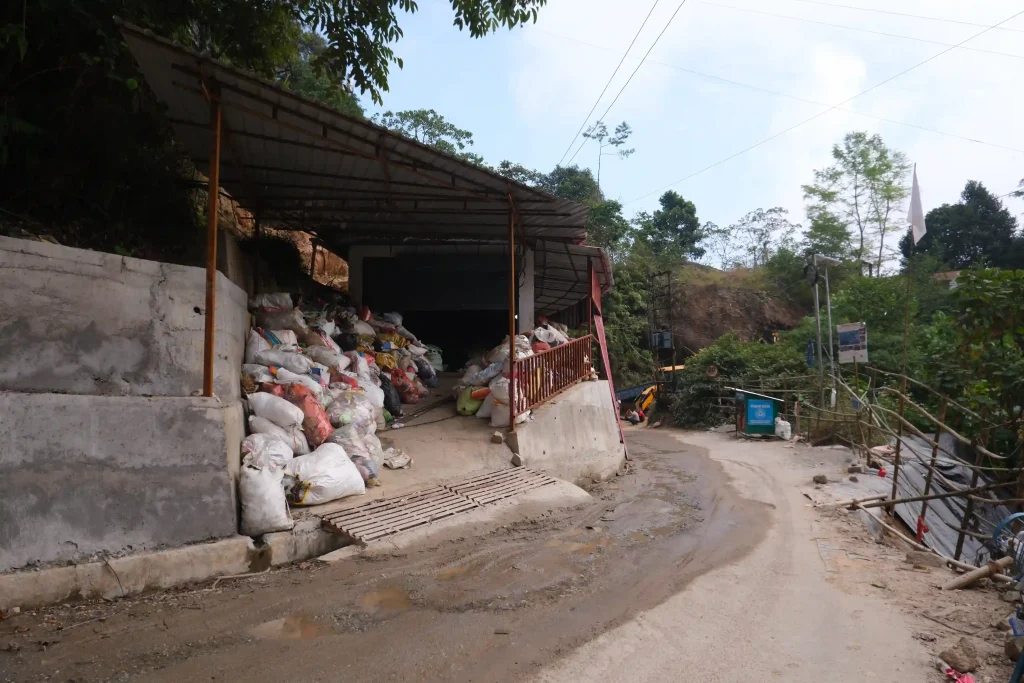
Funded by the Swachh Bharat Mission (SBM), the unit stands on the persistence of Shri M.K. Pahari, Block Development Officer, Rangli Rangliot. Later named a Sanitation Champion by the Panchayats and Rural Development Department, Pahari brought in TIEEDI after noting their work. TIEEDI began by training personnel with no prior experience in waste management and, over time, was entrusted with running the entire facility.
On the 15th of September, it was inaugurated as the first Swacch Block in the presence of officials from the District Rural Development Cell and DCB Bank, a generous supporter. Utsow Pradhan, Founder of TIEEDI, delivered a pledge committing themselves to the vision of a waste-free hills.
Operations now sit with Suraj Tamang of TIEEDI, an educationist and Swachh Bharat master trainer. When he assumed charge in April, written records were absent. The process began with a thorough audit with the panchayat: Has waste ever been quantified? Which households are complying? In five months the team standardized routes and records. Today there is an audit trail from the households to the TIEEDI MRF (Material Recovery Facility).
From Records to Routine
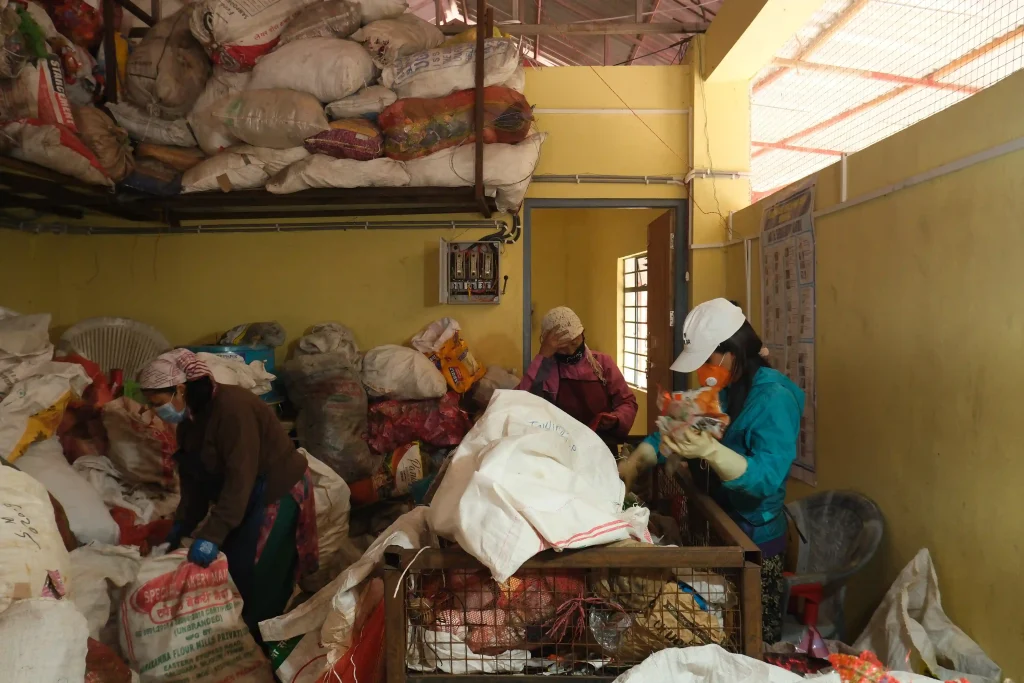
The Rangli Rangliot unit buzzes with the work that defines systematic waste segregation. A large Waste Segregation Guide hangs over four women at a segregation tray, insisting that its categories become muscle memory.
The staff, an all-woman crew, are called the Swachhta Praharis, or Cleanliness Guardians. In a district where most women’s incomes come from fields and home businesses, they arrived at the unit with a steep willingness to learn. The stigma of being branded a “waste worker” meant some hid the truth at home.
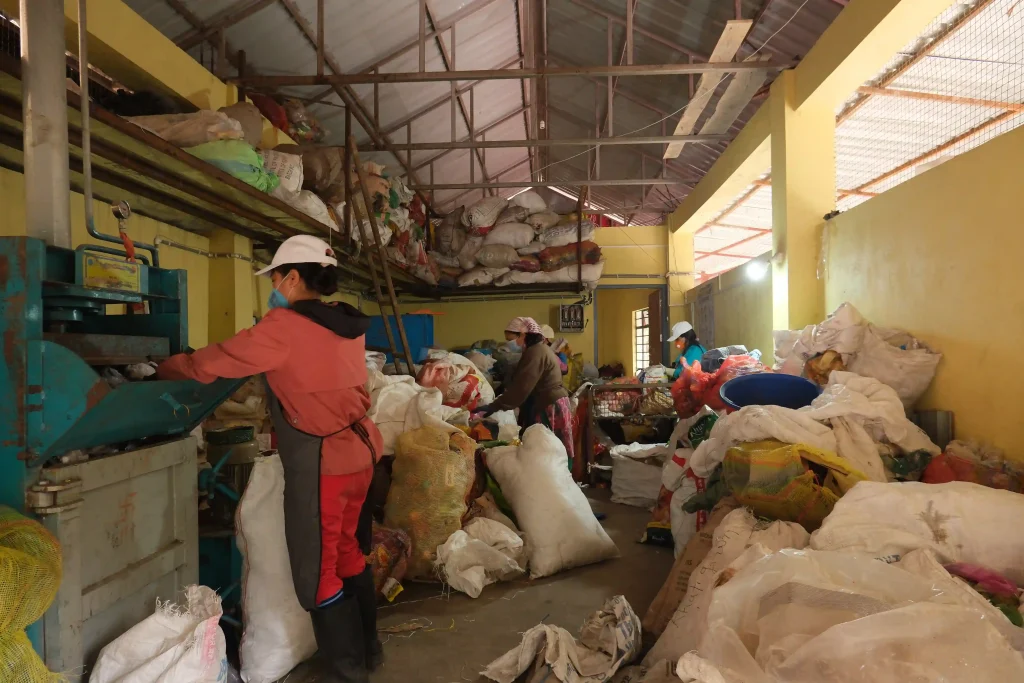
But what they did not hide is their desire to become like Rita Rai, Green Mile lead, precise at the tray as well as in her natural leadership; possessing the ability to move between training households and school-children in ways that make the work immensely dignified.
Read Also: The Green Mile Story: Darjeeling’s Zero Waste Revolution
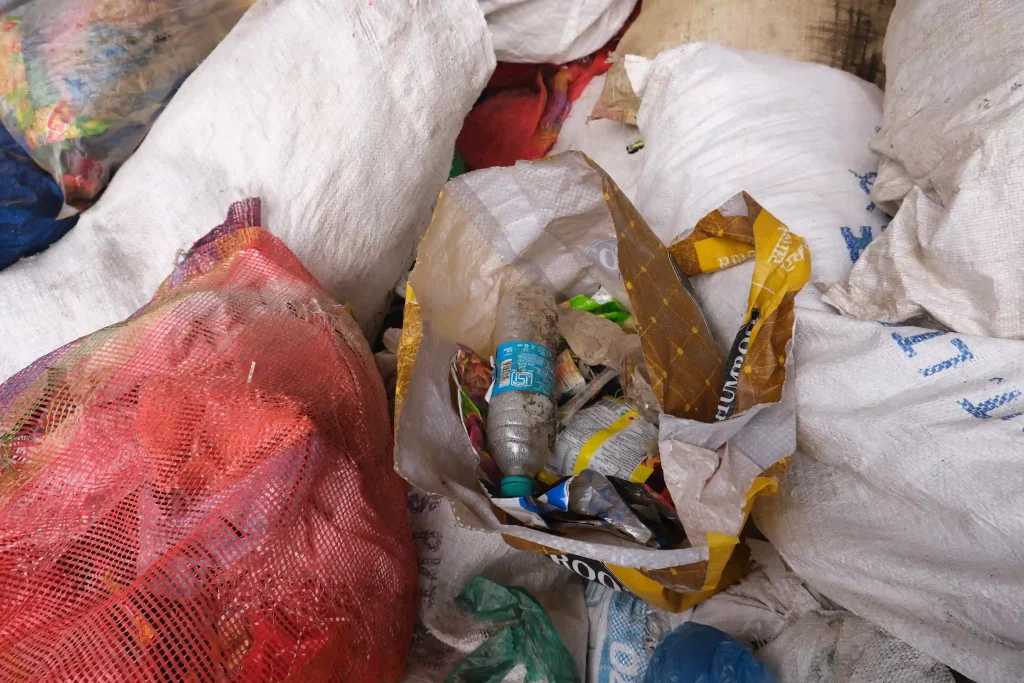
The Swachhta Praharis move briskly between stations. Their path is cleanly charted and everyone’s duties move in accordance with the law. Weights read and written; PET, paper, and metals baled for authorised buyers; the stubborn MLP (Multi-layered-plastic) tallied for producer take-back.
The early loads were mostly no-value waste. Even so, the unit had to take them. High-value material rarely reached the tray because scrap pickers lifted it before collection. That meant capacity had to be built around low and mixed value streams.
“We audit every sack from every panchayat. When waste is clean and properly segregated, the value goes up. Separate bottle and cap. Remove the neck ring and label. Crush and bale. The rate moves from 20 to 25 rupees per kilo and the upcycler can start right away. We keep records and we recognise the people that send it right.” Suraj adds, animatedly.
The site is edging into becoming the first model territory in the region. About seventy percent of the stream is now steady. However, with the Swacch Bharat Mission window closing, costs return to the unit unless revenue trickles in. That can look like a legally binding collection fee model, increased block budgets, Corporate Social Responsibility, or pooled Extended Producer Responsibility pickups.
In fact, a simple subscription model is needed in hill towns; if a Netflix subscription can be automated, waste-collection payments should be too. Clear collection terms here, then replication in Kurseong, Darjeeling, and even nationally. The fix is paperwork meeting intention and action.
Turning Compliance From Poster to Habit
Whether a unit lives or dies depends on who occupies the Block Development Officer’s chair. Funds need to be allocated on time. Ward committees need to exist on paper and on the ground. Reviews need to be regular enough that compliance shifts from poster to practice. Takdah is different because Shri M. K. Pahari, Block Development Officer, Rangli Rangliot, made these basics a priority.
The people need to be receptive too. “Before you build a unit,” Suraj says, “you have to speak to every household.” In his view, if the first thing they resonate with is an emotional reason, they make space for a system.
Despite being the district’s only operational MRF in recent years, enforcing source segregation remains a daily challenge. The habit will only stick with GP by-laws that back the routine and penalise violations.
Read Also: The Green Mile Story: Darjeeling’s Zero Waste Revolution
Challenges That Bite
The hills complicate cookie-cutter policies drawn for the plains. In fact, most of these policies had to be envisioned from scratch. Terraces slip and one long rain can bend a month’s plan. Logistics also cost more here because of scattered wards. This means that collection-to-MRF chains break without transfer stations and reliable vehicles.
An early audit showed how small acts change the math: uncrushed PET capped a run at about 150 kilos, while a quick stomp before bagging lifted the payload to about 500 kilos, roughly three times more on the same route.
A similar arithmetic governs markets. Dry waste needs a costly ride to Siliguri. A nine-ton cap over distance turns storage into a burden. Compost moves only when hotels and tea gardens commit. Without steady offtake, the numbers do not hold.
Publish the Routine; Politics Follows
Given all this, one does not need to look far to see why towns choose the quick fix: dump, burn, move on. Yet, Takdah and TIEEDI show another way. The unit runs on clean ledgers and clocks that are kept. The team is paid fairly and cared for with weekly yoga sessions. Data breaks a massive problem into workable chunks, and care breaks the strain on bodies that sort through other people’s refuse all day.
The philosophy is simple: do this work so the forest stops catching what people drop. Publish the standard operations so others can replicate it. Once the routine is visible, politics tends to follow.
I step out of the building to gaze at the small valley below. A longing for a pristine, untouched world graces my heart. I imagine myself to be the first foremother looking down at a cascade of flowering trees, orienting herself to a land meant to be felt through, not disrespected. The longing dissipates as I re-enter the present. What remains is plainer and kinder: a woman sorting waste at a tray, a bale cinched tight, and a forest slowly being unclogged.


